
Looking
deeper into today's
social realities

Across Europe, an increasing number of people are living in poverty and facing social exclusion. These realities are not only defined by their scale, but also by their complexity.

Situations of vulnerability often emerge at the intersection of multiple, interconnected barriers:

Persistent poverty and insecure employment

Limited access to housing, education or healthcare

The digital divide

Forced migration and displacement

Discrimination based on origin, religion or gender

Ageing, disability and mental health challenges

These factors rarely exist in isolation. They overlap and reinforce one another, creating diverse social situations that require adaptable and well-informed responses.

This makes the role of the social sector more important than ever.

Social intervention professionals work on the front line to support vulnerable individuals, families and communities, designing responses that address immediate needs and aim to generate sustainable change over time.

However, the growing complexity of these issues is contrasted by the limited use of advanced digital tools in the social sector. This continues to present challenges when it comes to data analysis, impact evaluation and the continuous improvement of social interventions.

DIGICARE emerges in response to this gap.

The project provides social sector professionals with practical training resources that make data management and artificial intelligence accessible in everyday social intervention. By doing so, DIGICARE strengthens the sector’s capacity to better understand social needs, design more effective interventions, and transition to innovative, evidence-based, people-centred models of social action.
Grounded in real experience

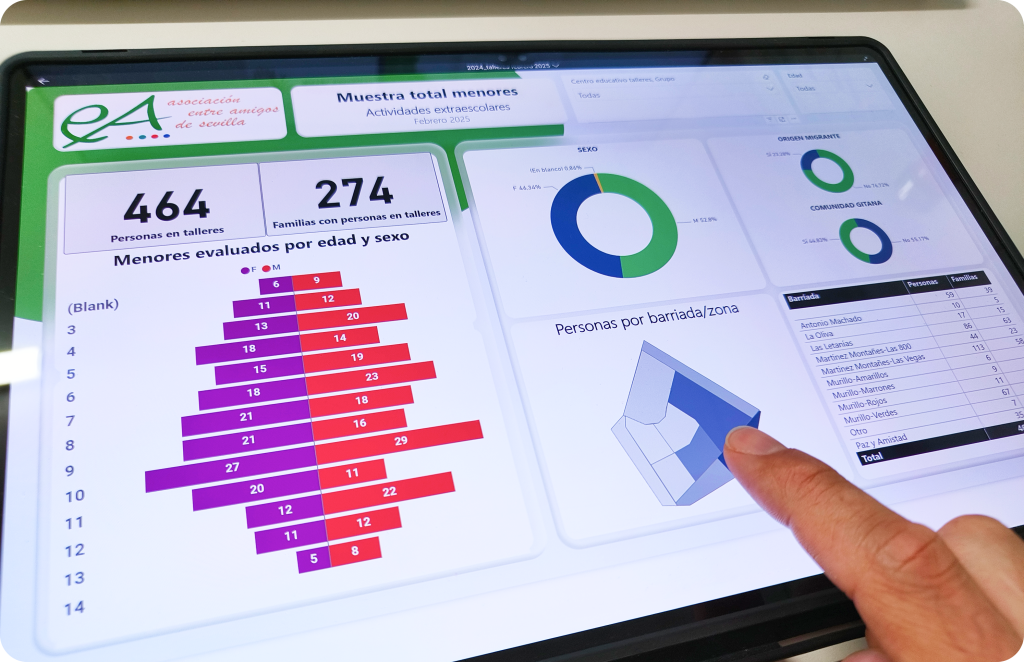
DIGICARE builds on the pioneering digital practices already used by some of our partner organisations for social intervention.

  • AMANDLA has developed a digital Monitoring, Evaluation and Learning (MEL) system to assess the impact of its socio-educational programmes.
  • Asociación Entre Amigos de Sevilla has also created its own digital tool for managing and following up on community-based social interventions in everyday practice.
  • UNISS offers to students a theoretical and practical training through lessons, seminars, workshops and internships for social educators working in situations of discomfort and social marginalization, indeed students have 275 compulsory hours of practical training during their academic training.

Our goals

Strengthening digital skills in social intervention

Providing practical training materials to help social intervention professionals develop digital competencies in data management and artificial intelligence.

Modernising VET and CVET training

Supporting the integration of advanced digital tools into VET and CVET training pathways for current and future professionals in the social sector.

Promoting evidence-informed practice

Encouraging data- and evidence-based ways of working to improve the planning, implementation and evaluation of social interventions in contexts of exclusion.

Funded by
Erasmus+

Erasmus+ is the European Union programme designed to support education, training, youth and sport across Europe.

The 2021–2027 programme has a particular focus on social inclusion, sustainability, digital transformation, and encouraging young people to participate in democratic life.